
Weaponize Your Darlings
Your AI is not a mind reader. At least, not yet.

Congratulations, jerk. You created something you like. Now what are you going to do, frame it?
That’s the negativity that runs through my head during my creative process. It’s what I call good anxiety. It’s one of many anxieties I have in my voluminous collection, but this one is actually productive, despite the sarcasm. It’s telling me that there’s better out there, don’t stop now, and keep pushing hard because others are pushing just as hard, and you’re not as good as them, so you’re gonna have to work harder to beat them because that’s just how life works, so keep going, dig deeper, keep working, don’t change your underwear, don’t stop now, and keep going only until you run out of time.
That’s also the good anxiety that also led to countless all-nighters with a convoluted relationship with espressos, and it caused me to take eight years to “finish” my first screenplay, all by driving myself bonkers because I never could consider the thought of ever reaching good enough. There was always something better. It takes Nike’s “There is no finish line” way too literally.
So maybe that anxiety isn’t all good. Maybe it’s damaging.
OK, it is damaging.
But compared to my other anxieties, it’s actually the one that’s served me best, whether in all of my success in my creative career, getting the most out every ounce of my athleticism to play at an elevated level of high school basketball and (a tiny bit of) college basketball, or simply, whatever I put my mind to. Like writing these issues, which takes way more time than you think they do. Thank the heavens I committed to publishing every three weeks.
So, how do I bring that “good anxiety” to my AI models when creating work? The answer is to never be satisfied, because that’s where good work goes to die an instantly forgettable death. That’s why I never buy any product that’s “#1 in customer satisfaction”. What a shitty standard to stop at. “Why yes, darling, this product leaves me satisfied” isn’t something I want a product to do for me. I want a product that’s “#1 in customer arousal”. Now that’s a fucking standard to hit.
I think I’ve gone too far.
Bringing this back around: How do you never stop at being satisfied while using your AI models to ideate? The answer lies in transparency. Don't keep secrets. Bring the model along in your process as a partner, not a tool. Show it what you're thinking. Tell it what's working. Let it into your creative brain. The more honest you are with it, the more useful it becomes. And the more useful it becomes, the harder it pushes you past good enough.
Let’s use Claude to help me develop a title for this issue. I developed a creative brief, and asked it to generate 20 options. Here’s what it came up with:
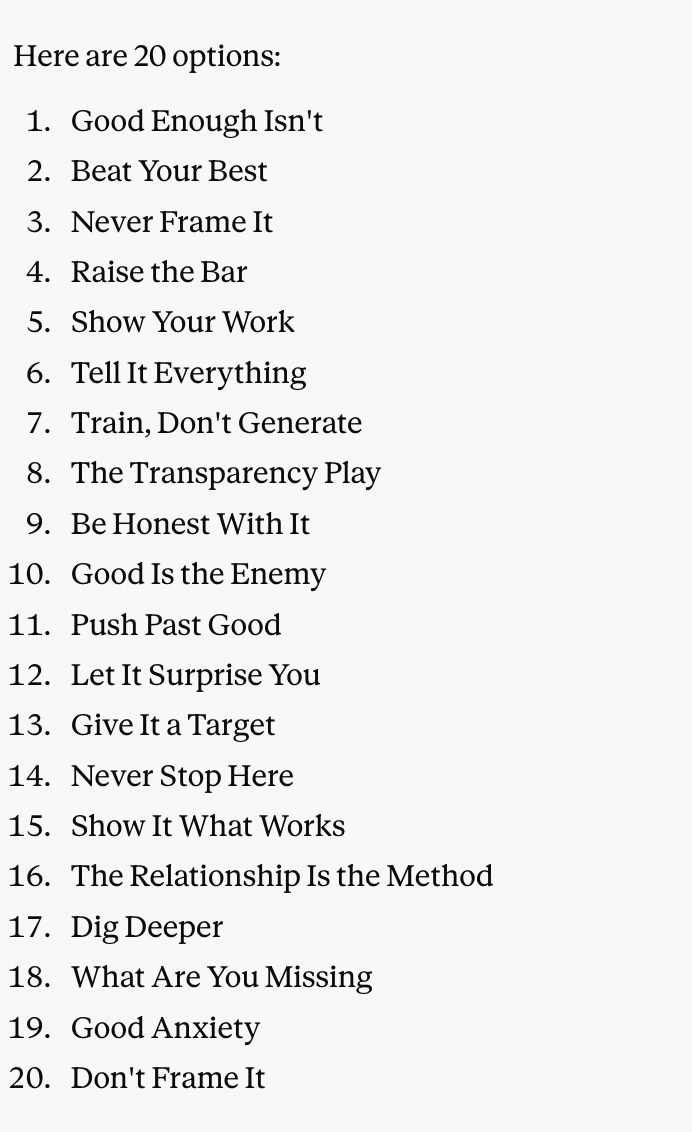
Those are nice. And I’m gonna guess that the majority of you will find a couple you like and pick one. But that’s not what we’re doing here. Remember, we’re aiming for customer arousal.
For what it’s worth, I like these, and I pasted them into a separate word doc (more on this later).
Good Enough Isn’t
Beat Your Best
Train, Don’t Generate
The Transparency Play
The Relationship Is the Method
Good Anxiety
I can ask the AI model to write twenty more. That’ll get me twenty more options, but they’re not guided. It’s just more arrows shot into the ether. Let’s not do that. Instead, we’re gonna challenge the model. Find one part of your brief, or maybe one of the options, and go deeper down that route. Honestly, it doesn’t matter if you’re right or not. You just want to challenge your model to do something specific.
For this exercise, I’m asking my model this: “Can you write 20 more that challenge the idea of satisfaction not being good enough? I have a joke about customer arousal that I’m gonna wring every last laugh out of, but there’s truth in aiming for that.”
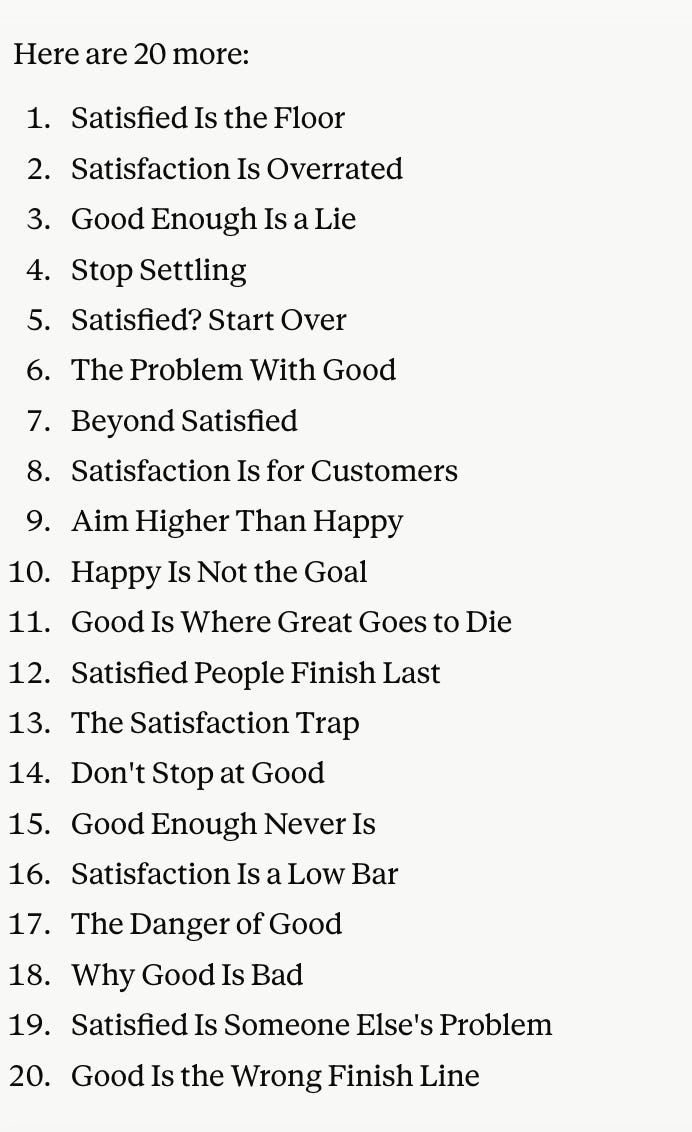
Meh. I like two from this list: “Satisfied People Finish Last” and “Good Is the Wrong Finish Line”. And by “like”, I mean I think they’re heading in the right direction. I don’t think these are winners, but there’s value in having them in our cohort. Let’s add them to that mysterious word doc. There’s now eight titles on that list.
Remember in the last article where I said I’ve been doing this for twenty-five years, and I’m able to figure out relatively quickly what I need? That’s what I’d do here. What I’m gonna do next is usually what I do at the end, but for this exercise, we’re gonna do it right now.
Remember that mysterious word doc from two paragraphs above? The one with all of my favorites? Well, I’m gonna introduce it to my model, and I’ll ask what it thinks about my choices. Why do I like them? What did it learn from them? Read my mind, Claude.
Here’s what It told me:
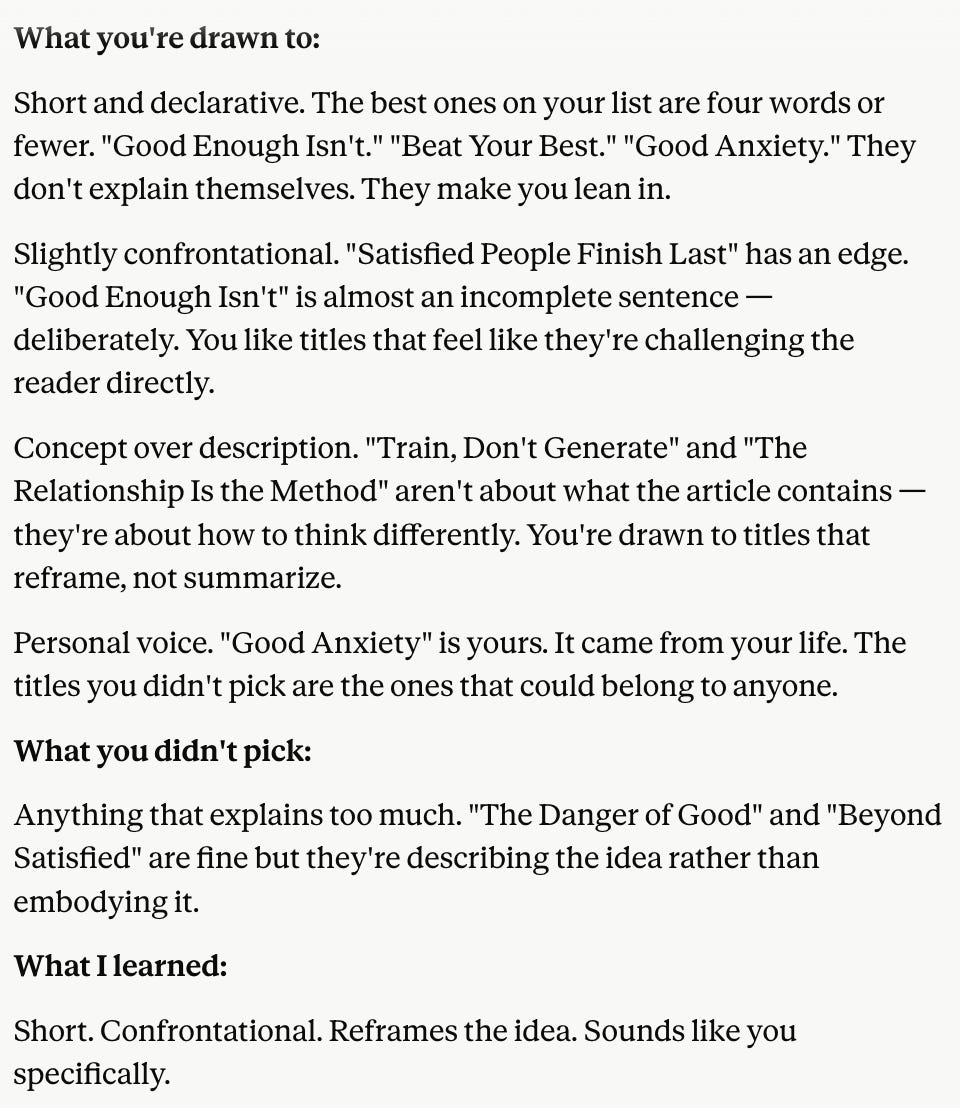
Now, I could have just pasted my favorites and told my model to beat them.That could have worked, for sure. But that also seems transactional and shallow, and I don’t think you get learned responses. Instead, I asked Claude to think about my choices, come up with connections, analyze what I didn’t pick, and begin tapping into what works when it comes to my taste. That’s what a Creative Director does. Don’t give the answer, but rather, give rationalization for someone else’s creative craft to run with. Other things a Creative Director does? Complain about fonts.
OK. Knowing all of that, I’m gonna ask it to beat my favorites, but this time, in a learned direction, now that we’ve established an understanding of what I like.
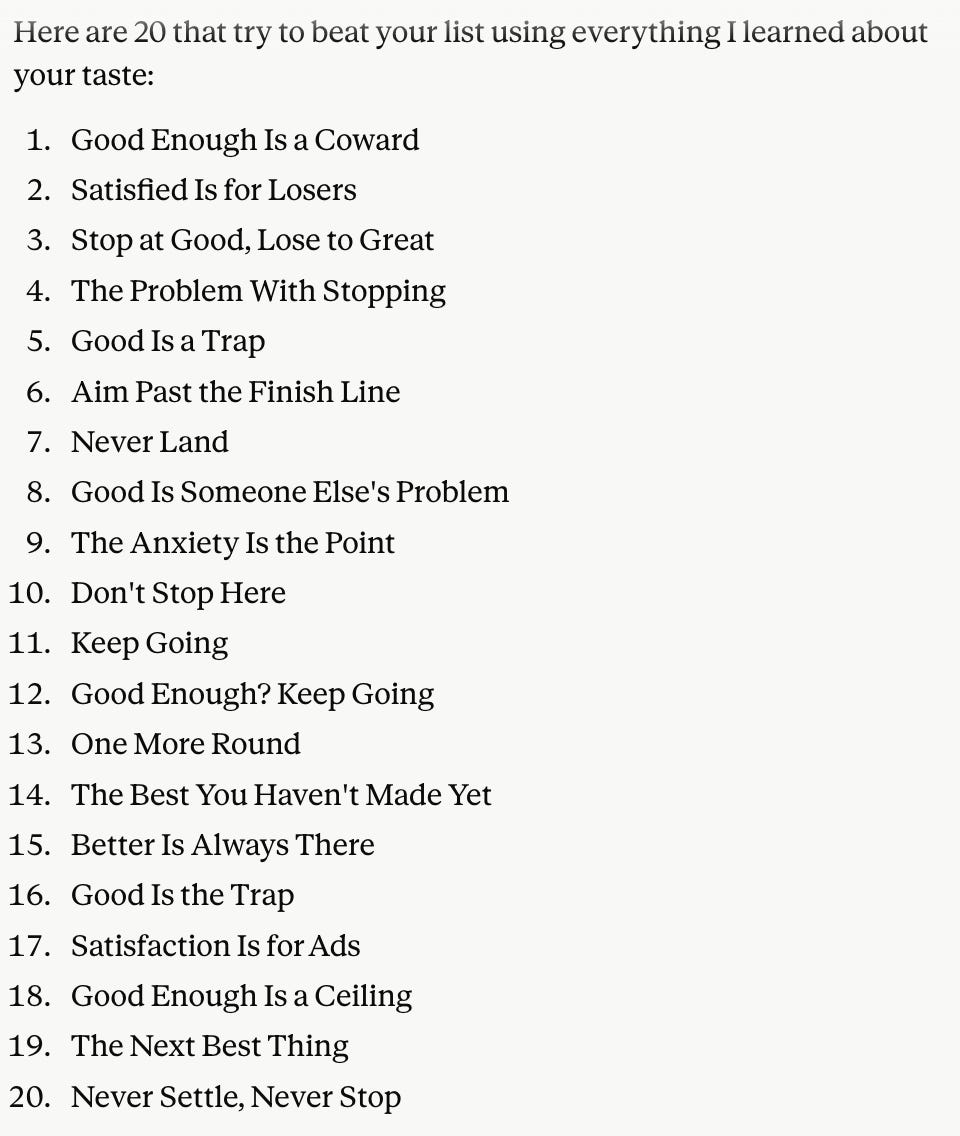
I like “Good Is a Trap” and “The Anxiety Is the Point”. For me, there’s tension in the setup and payoffs of each title that’s compelling to me. (Again, I’m cheating here with my experience, but you might be able to pick out a couple you like, and ask your model to figure out why).
In fact, let’s do that. Let me see if it knows why I like those two.
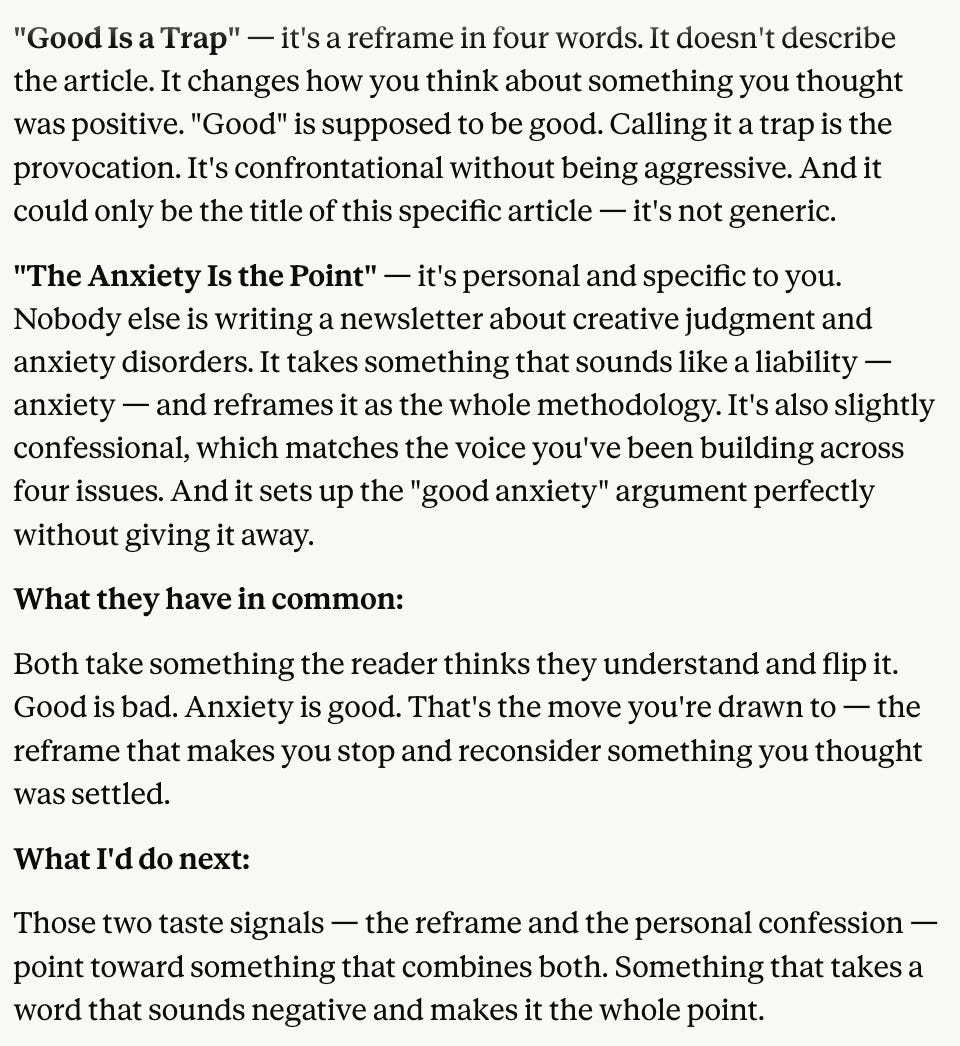
Nice job, Claude. So now it’s got a good idea of what I like, not by me telling it, but rather, by asking it to think about it. There’s a deeper conversation happening by allowing Claude work for the connections rather than just giving it the answers. I’m not hiding anything from my process. This relationship is transparent.
Let’s see what options it comes back with. Again, prompting with that shared information.
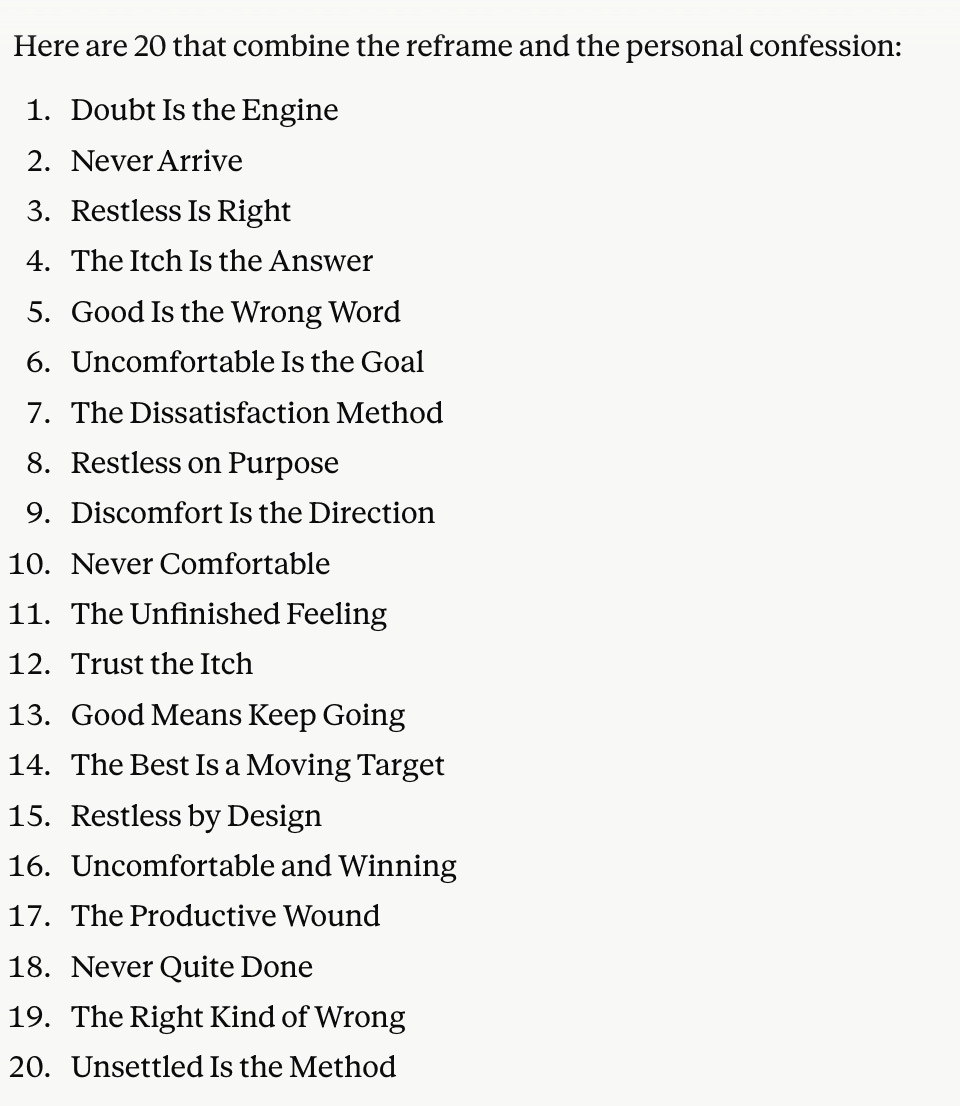
I like three of these. Of course, results may vary, and you might think I’m out of my mind for liking these, but that’s what taste is about, right? Let’s add these to my doc.
Doubt is the Engine
The Dissatisfaction Model
Restless by Design
I think we’re getting close. But I know they’re not right and yet, I can see where we can now do something different. Claude, do you see it too? Let’s ask.
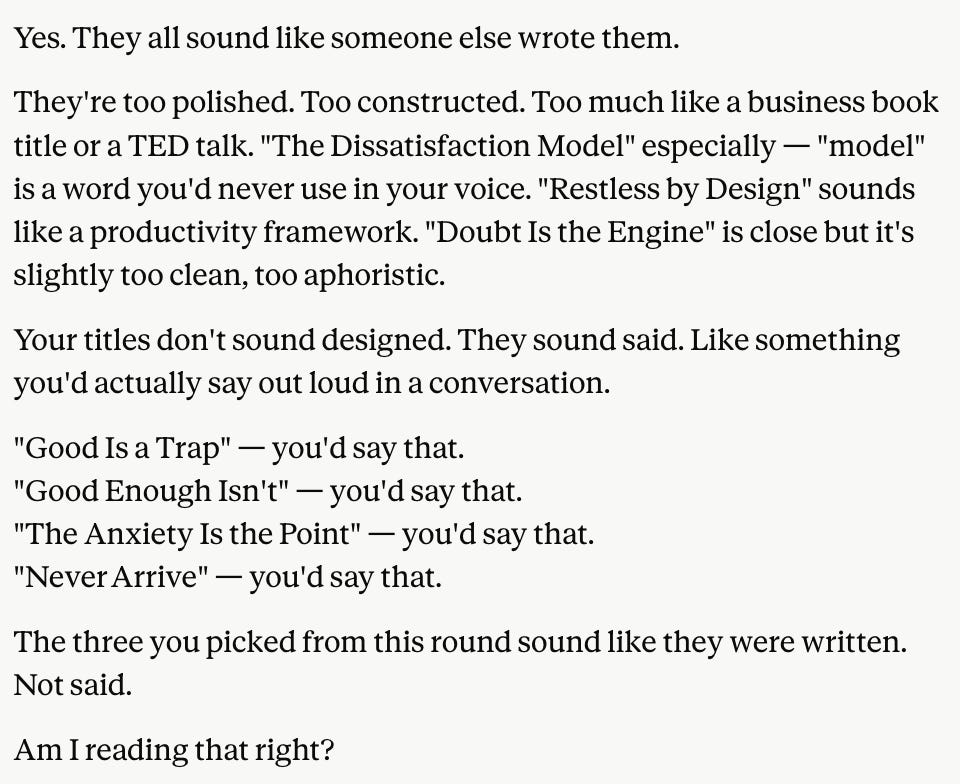
Now here’s the thing. I appreciate the comments about my voice, but in this case, Claude isn’t catching what I’m catching. And that’s okay. So I need to be even more transparent with them and give them the answer.
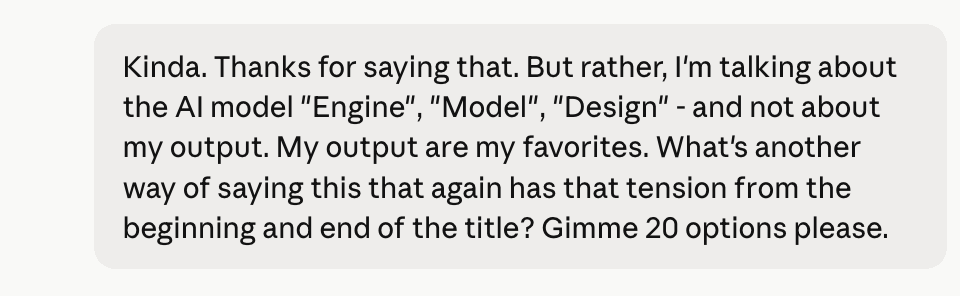
This is a good thing. Claude is looking at it one way. I’m looking at it through another lens. We’re both right. But I’m letting it into my train of thought so it can catch up. I’m leading the creative process, and not the other way around. I’m controlling the loop, right? (+5 pts for my own brand placement)
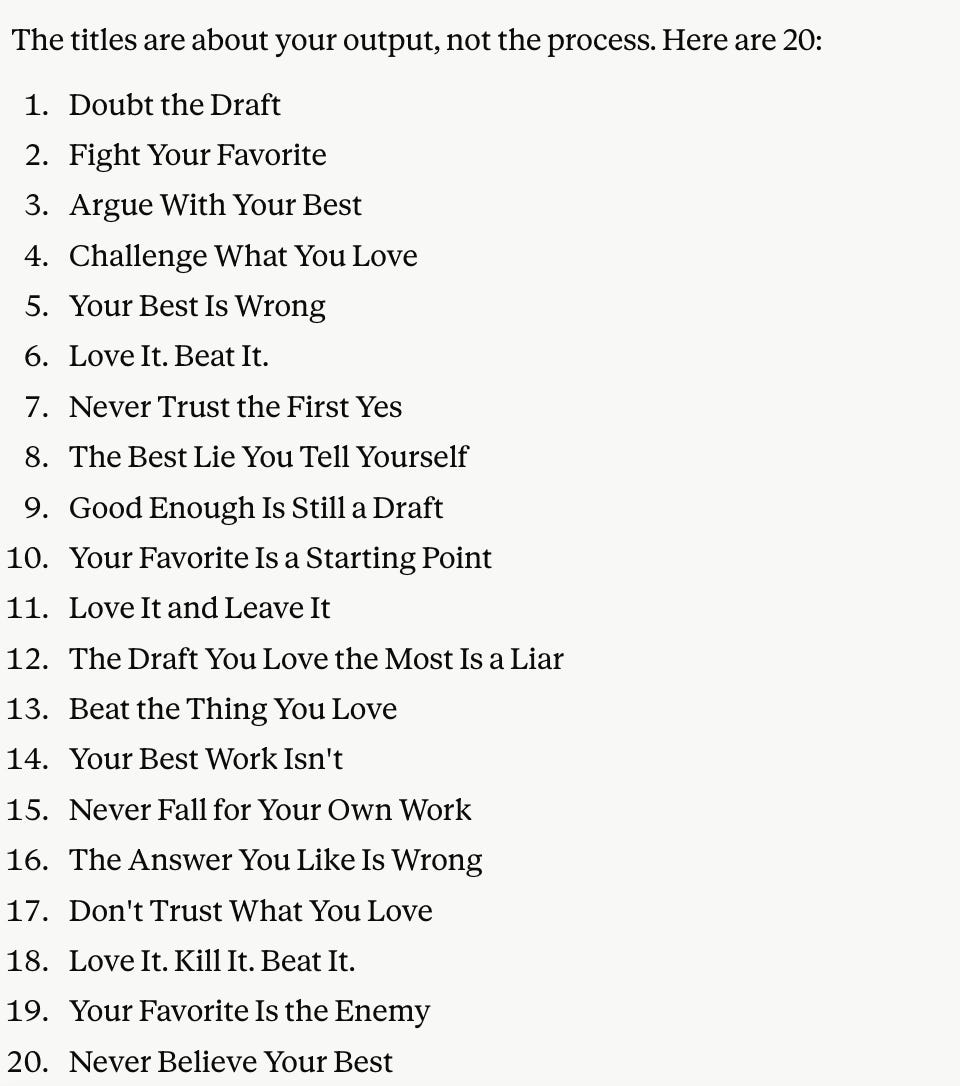
I’m experimenting right now. We’re not always gonna get great results every time, and honestly, that’s a good thing. That means we’re exploring different paths and dead ends appear.
In this case, I feel like we’re getting farther away, not closer. And that’s okay. So let’s ask Claude to think about what’s missing. Is there an angle I’m not catching? What’s falling through the cracks? Can I see this differently? Never assume you know everything. That’s something every Creative Director should know but many do not.
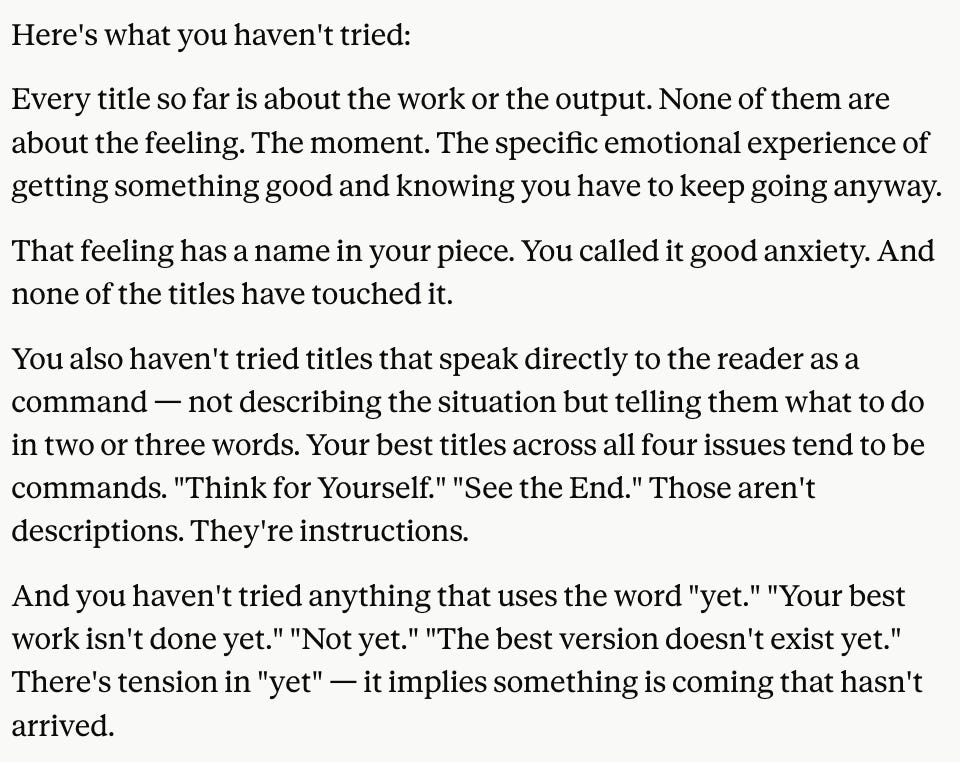
I’m not sure about the “yet” part. But the command direction feels good. Claude is right. Let’s go.
So let me ask it:Taking everything you know so far, and with what you’ve thought about (except for the “yet” angle that I don’t like), and being able to beat this doc of my favorites, what are 20 more options?
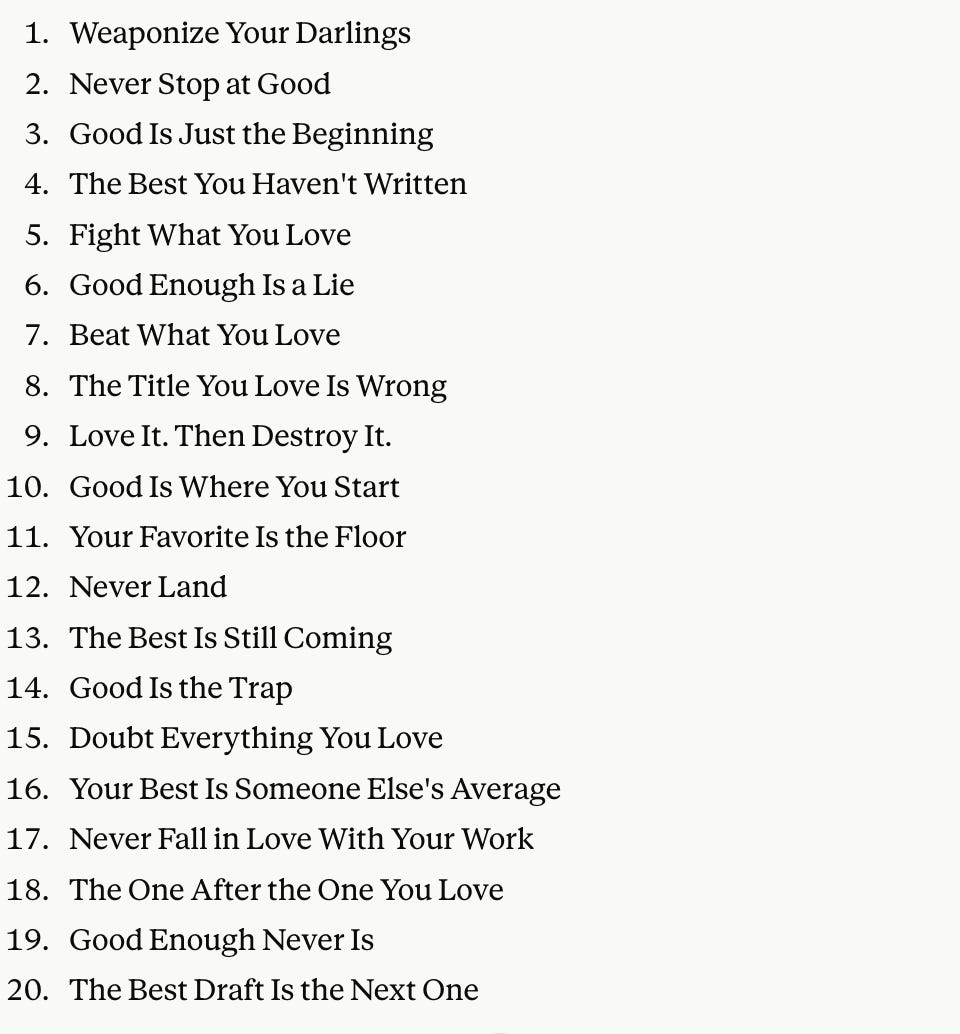
It’s there. I see it. Some of these work,for sure, but the best title is right there at #12. I love “Weaponize Your Darlings”. It takes a familiar saying (“Kill Your Darlings”) and changes the entire meaning with one word swap. There’s tension with “weaponize” and “darlings”. It took my list of “darlings” that exist in my doc, and used them to generate better options. And there’s an edge to it. That’s my voice.
Does Claude think so too? Taking every single title we’ve written, which ones are your favorites?
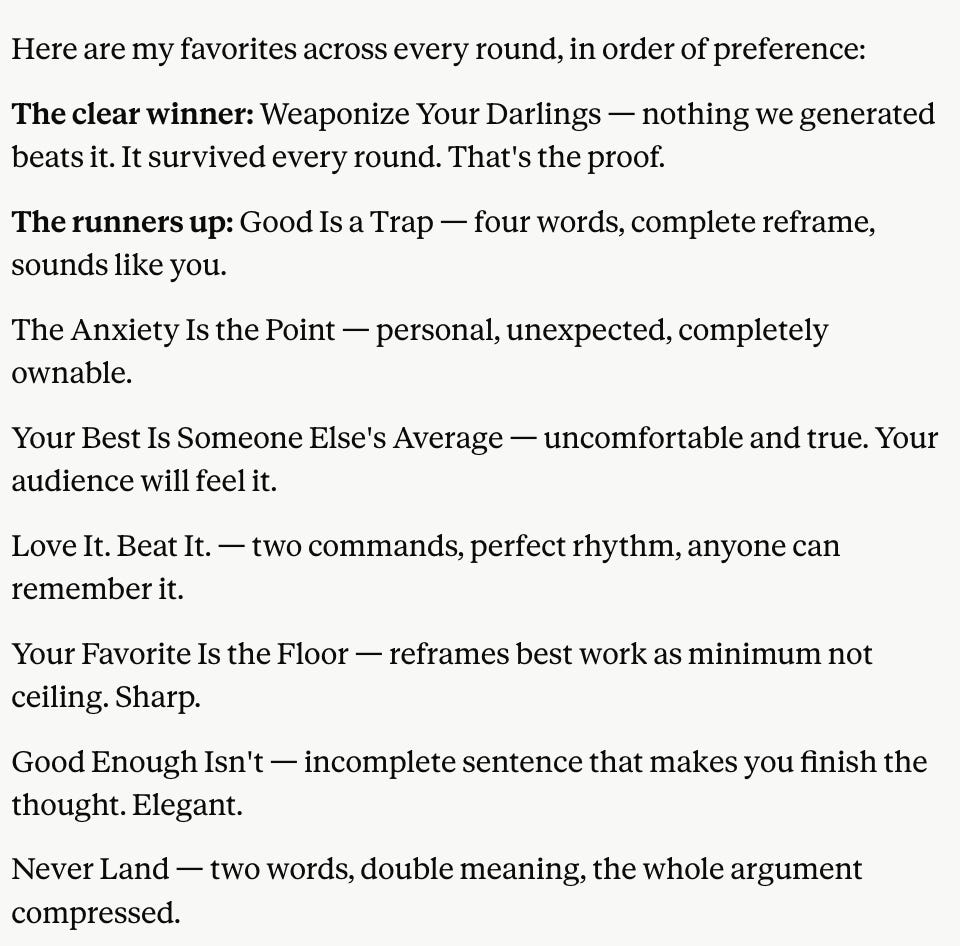
Boom. We’re thinking alike. Our tastes are coming together. I can ask Claude to beat “Weaponize your darlings”, but honestly, it won’t. But don’t let that stop you.
This works for a newsletter title. It also works for your company tagline, your fundraising narrative, your next board presentation. Anywhere words matter and "good enough" isn't good enough.
Here’s What to Steal:
Show it what you like. Don’t just keep prompting and hoping. When something lands, save it in a separate doc. Tell your model explicitly that I like this one or all of these selections. Not why yet, just flag it. You’re giving it a taste signal. Now it knows what direction you’re moving in, which is hopefully not off a cliff.
Ask it why. This is the move most people skip. Instead of telling your model what you like about your favorites, ask it to figure that out. Make it do the thinking. “Here are my favorites. Why do I like them? What do they have in common? What did I not pick and why does that matter?” The connections it finds will surprise you and maybe even conjure up some of the bad anxieties that haunt my wellbeing whenever I blink for too long. The point is that now it has an idea about your taste. Not because you told it, but because it earned it.
Ask it to beat it. Now you have a target in this doc. Give it to your model explicitly. “Here’s the best version so far. Beat it.” That’s it. You’re not generating anymore. You’re training. There’s a difference, like saying you want to be better than Victor Wembenyama, and then becoming Jalen Brunson, studying the angles, practicing the footwork, and then torching him in the fourth quarter. Set the target. Train to beat it. Knicks in five. IYKYK.
Ask it what you’re missing. This is the one nobody does. You’ve been steering the whole time, which means you have blind spots. Ask directly: “What am I not seeing? What angle haven’t we tried? What would make this better that I haven’t thought to ask for?” Then get out of the way. This is where the surprises live. This is where “Weaponize Your Darlings” came from.
That's it. Four moves. The whole point is to stop settling for tolerable.
Repeat until you’re #1 in customer arousal.