
See the End
Turns out, “make it pop” is not a creative brief

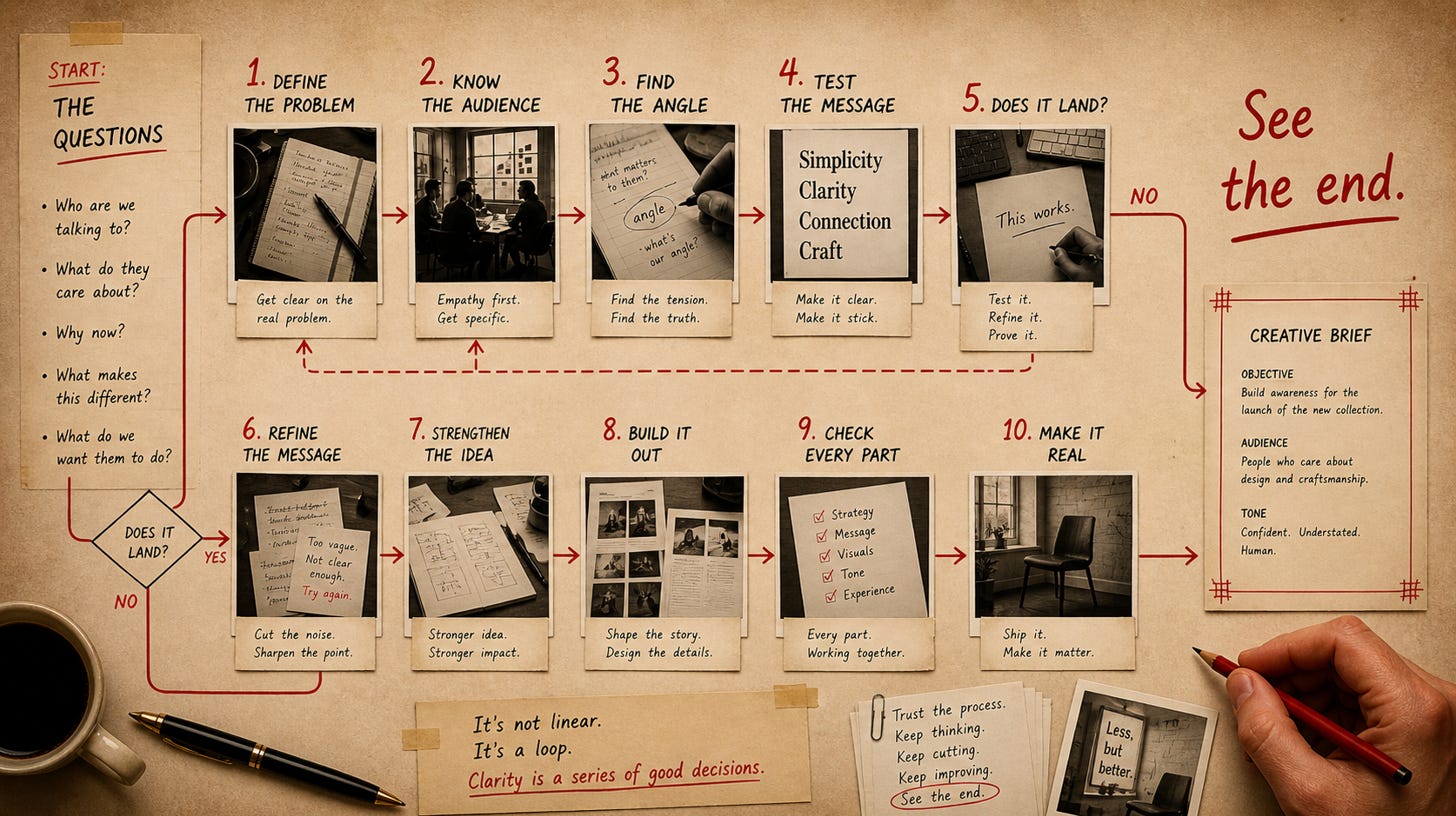
Most people use AI like a vending machine. Put something in, take something out, hope for the best. The results are exactly as good as that sounds.
The problem isn’t the AI. It’s that there’s no barometer for what good looks like. So whatever the AI spits out gets judged on its own merits and not against any sort of standards. You’re grading your own homework. You’ll pass every time. The work will still be terrible.
The fix is a creative brief. Because it always is.
A creative brief serves as your north star. It’s a simple document that forces you to answer the hard questions before you start making anything. Who is this for? What do they believe right now? What do you want them to think afterwards? What’s the one thing you’re trying to say? What does success look like? Five questions. That’s it. Less than a therapy session and significantly cheaper.
So when you produce work, you can then judge it based off the brief you created. That’s how you know if you’re on the right path. Does it answer the brief? Good. Does it not? Figure out why and start over.
That’s the basics of the creative process. There’s no use trying to hit a target you haven’t drawn yet.
If you have a creative strategist on your team (and you really should, because they’re the ones who actually know what they’re doing), this is their job. But if you don’t, or if they don’t have the bandwidth, that’s not a reason to skip this step. It just means you need another way to build one.
Truthfully, writing a brief from scratch can be a daunting task. And that’s especially true when you don’t have the time to put one together. Sure, you can outsource it to your AI, but guess what? It’ll just regurgitate a document about nothing, formatted beautifully.
We don’t want that.
Here’s one way I use AI to help me build a brief. I tell my AI (in this case, Claude from Anthropic) to be the strategist and to ask me, the project owner, questions about the task. Costumes optional. This way, we’re not filling in blanks like it’s homework. It interviews me. I get follow up questions. I’m bringing the humanity and insight into the process. It feels looser and friendlier. And in the course of the conversation, the AI is building out a creative brief in the background.
Here’s what I mean. This is me and Claude going back and forth about a creative brief for this article you’re reading. It’s unedited.

See what happened? Claude interviewed me in a way that felt conversational, and I was able to then respond freely. And it asked questions I never would have thought to ask myself. Like presenting an assignment at the end of this article? I swear, that wasn’t in my blueprint when I started thinking about this article. The AI found it. I kept it because it was right.
Here’s the creative brief it generated.
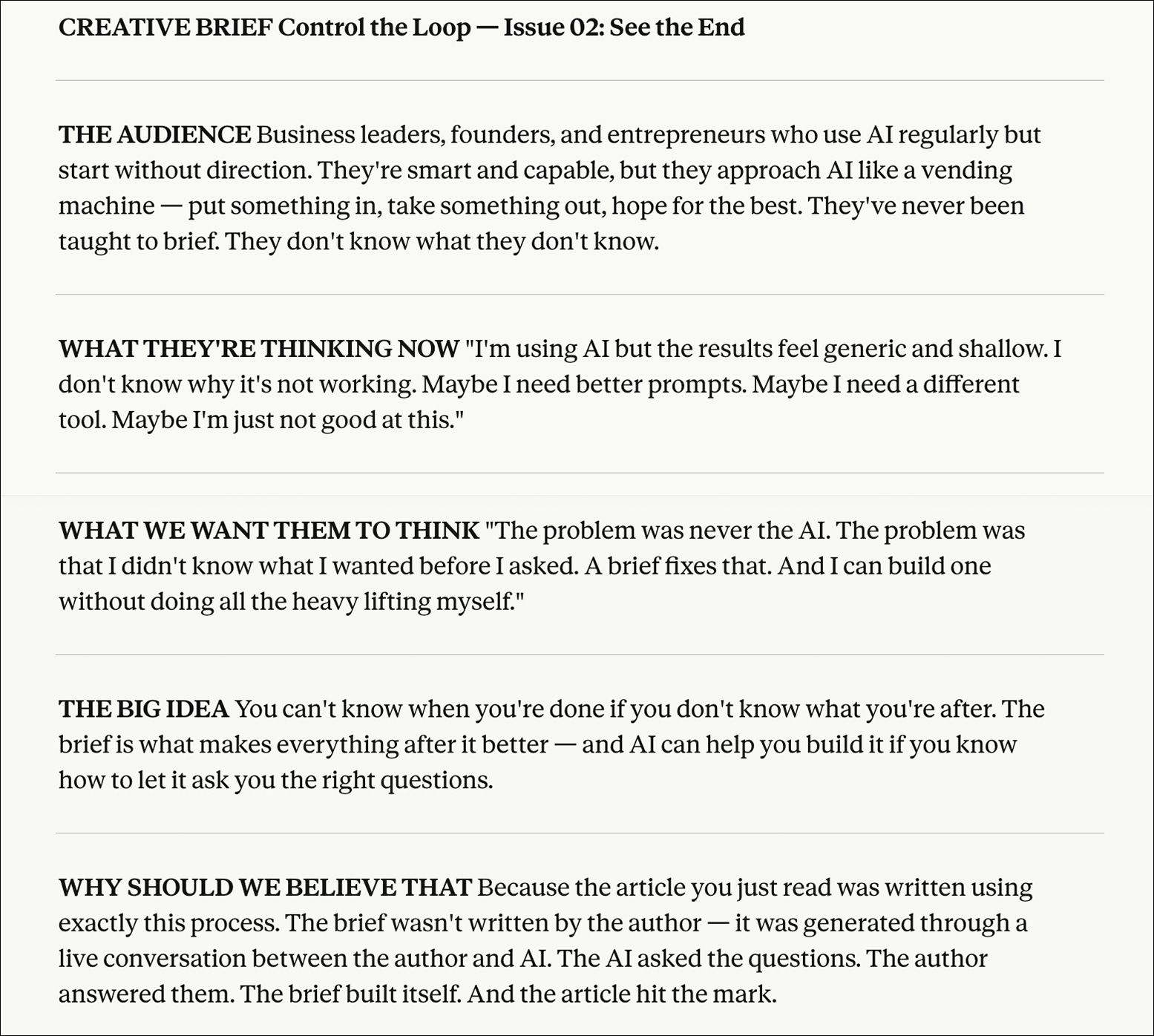
Nice, right? It’s not as airtight or thorough as what a creative strategist would create. But it’s a solid document. And it provides me with a standard to judge my work against.
Now let me take that brief and make it my own. I like my briefs to be brief, pun intended and instantly regretted. I also like to type them onto official Control the Loop letterhead.
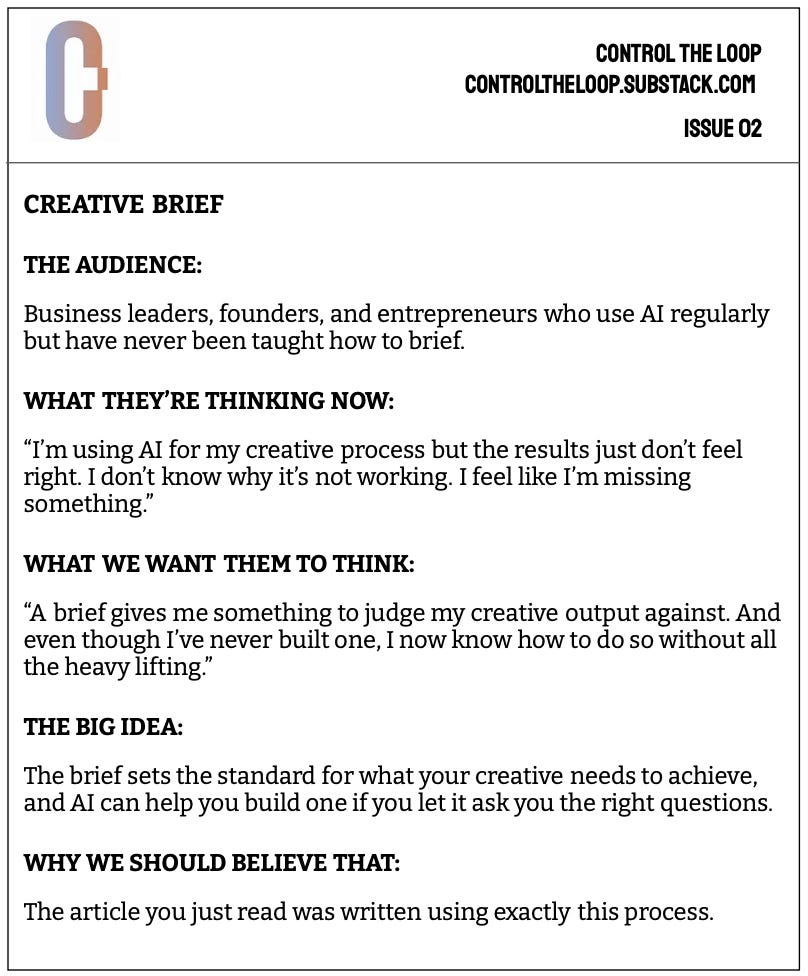
The brief does one thing. It tells you what correct looks like before you start. Everything after that is just execution.
Building a brief doesn’t have to be a tedious hostage negotiation between you and a blank word doc. Instead of flipping it the finger and disappearing into Midjourney, use your AI as a partner to create a thoughtful, human brief.
Treat it as you would any teammate. Ask it questions. Answer some of theirs in return. Be honest. Be okay to not know something. Allow the AI to explore. Give it enough to strategize. The brief you both create might not be perfect, but it beats nothing, and it gives you a target to aim for.
I just read the creative brief again and now this article and I gotta say: Nailed it, sucka!
Here’s the assignment I never planned on giving. The AI suggested it, a great idea can come from anywhere, and honestly, isn’t that the whole point of having a partner on this creative journey?
Based on what you've read so far about how I think, what do you think the brief for my next issue should be? Post it in the Chat. I'm genuinely curious, slightly scared and half turned on, and the best one might just shape what I write next.
Smart. I'm preaching this everywhere now — don't ask it to solve your problem, ask it to help *you* solve the problem. If you're a problem-solver, then you have to work the problem 'til it hurts -- and AI can help you do that in a structured way. That friction helps us learn, helps us think, and changes our brains in subtle ways that lead to creative solutions later.